
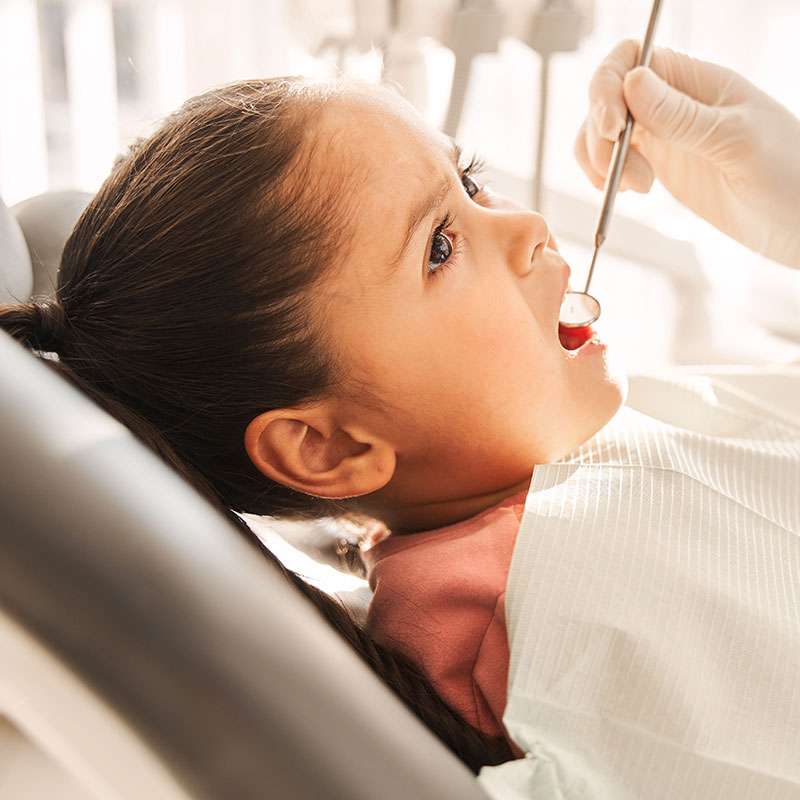
Keeping your child’s teeth healthy starts with prevention. Dental sealants offer one of the most effective ways to shield your child’s back teeth from cavities. The process is quick, comfortable, and involves zero discomfort.
Pediatric dental teams see firsthand how sealants help children maintain healthy smiles throughout their cavity-prone years. Here’s how sealants work, what they cost, and when your child should get them.
What Are Dental Sealants for Kids?
Dental sealants are thin, BPA-free resin coatings applied to the chewing surfaces of children’s molars and premolars. They bond directly to tooth enamel and fill in natural grooves where bacteria and food collect, creating a smooth barrier that prevents cavities. According to the Centers for Disease Control and Prevention, sealants prevent 80% of cavities in back teeth for two years after application, and they continue providing defense for several years beyond that.
Picture a tooth’s top surface as mountains with many grooves. When your child eats, food gets caught in those grooves. Even with careful brushing, toothbrush bristles often can’t reach deep into these tiny crevices where bacteria love to hide and multiply.
By filling in these grooves, sealants create a flat surface that’s much easier to clean. This is why board-certified pediatric dentists consider sealants a standard preventive treatment. They act as a physical barrier, stopping food particles and bacteria from settling into the spots most vulnerable to decay. For children who are still learning proper brushing technique, that extra layer of defense can be the difference between a healthy tooth and an early cavity.
How Are Dental Sealants Applied? The Step-by-Step Process
Parents often ask if getting sealants will be stressful for their child. The good news? This is one of the easiest dental experiences your child will ever have. There’s no tooth preparation involved, no discomfort, and the whole process takes just a few minutes per tooth.
Here’s exactly what happens during a sealant visit:
- Cleaning the tooth – The dental team thoroughly cleans the tooth to remove any food particles or plaque from the surface and grooves.
- Preparing the surface – A mild acidic gel is applied briefly to roughen the enamel slightly. This helps the sealant bond securely to the tooth.
- Rinsing and drying – The gel is rinsed away completely, and the tooth is dried again to prepare for the sealant.
- Applying the sealant – Liquid sealant material is painted directly onto the tooth’s chewing surface, flowing into all the grooves and pits.
- Curing the sealant – A special blue light is used to harden the sealant in just seconds. Once cured, the coating is firmly in place.
Your child can eat and drink normally right after the visit. Most children don’t even realize anything has been done to their teeth because the sealant is thin and comfortable.
5 Key Benefits of Dental Sealants for Children
Why do pediatric dentists recommend sealants so frequently? Here’s a quick summary:
- Significantly reduce cavity risk in molars, backed by CDC data
- Completely comfortable application with no tooth preparation needed
- Each application lasts five to ten years with proper care
- Cost-effective compared to restorative treatments
- Targeted defense during the years when children are most vulnerable to decay
Below, each benefit is broken down in more detail.
How Much Do Sealants Reduce Cavity Risk?
According to CDC data, sealants have been shown to reduce the risk of decay in molars by nearly 80%. For children still developing their brushing skills, this added defense makes a real difference. Back teeth have the deepest grooves and are the hardest for young patients to reach with a toothbrush, making them the most common site for childhood cavities. Board-certified pediatric dentists, along with the American Academy of Pediatric Dentistry, recommend sealants as a frontline preventive measure for this reason.
Zero Discomfort During Application
Unlike other restorative treatments, sealants require no numbing and no tooth preparation. Children often describe the experience as “easy” or even “boring” because nothing uncomfortable happens. That routine feeling helps build positive associations with dental care early on.
How Long Does Sealant Coverage Last?
With proper care and regular dental exams, sealants can shield teeth for five to ten years. Your pediatric dentist will check them at each visit and reapply if any wear occurs. Many children only need one application per tooth during their school-age years.
A Smart Financial Choice for Families
Preventing cavities with sealants can save money on future dental treatments. A sealant costs a fraction of what you’d pay for a filling, crown, or other restorative work down the road. When you weigh the minimal cost against the expense and time involved in treating a cavity, the math is straightforward.
Why Childhood Is the Critical Window
Children between ages 6 and 14 face the highest risk for cavities in their permanent molars. Sealants provide a shield during exactly the years when your child needs it most. These are also the years when dietary habits, like snacking and sugary drinks, tend to increase, making that physical barrier over the tooth surface even more valuable.
Dental Sealants vs. Fluoride Treatments: How Do They Compare?
Many parents wonder whether their child needs sealants if they’re already getting fluoride treatments. The short answer: both treatments work differently, and they’re most effective when used together.
| Feature | Dental Sealants | Fluoride Treatments |
|---|---|---|
| How it works | Creates a physical barrier over grooves | Strengthens enamel chemically |
| Where it protects | Chewing surfaces of molars only | All tooth surfaces |
| How long it lasts | 5-10 years per application | Requires reapplication every 3-6 months |
| Application method | Painted on and cured with light | Applied as gel, foam, or varnish |
| Best for | Deep grooves in back teeth | Overall enamel strength |
Teeth are composed of many tiny pieces called molecules that attach to each other. These tiny pieces are constantly breaking apart throughout the day and reforming depending on diet. Fluoride can be thought of as a “glue” for these pieces by keeping the molecules more tightly bound together and less prone to breaking apart.
While fluoride strengthens the entire tooth surface, it can’t fill in the deep grooves where most childhood cavities develop. That’s where sealants step in. Pediatric dental teams typically recommend combining both treatments for maximum cavity defense, because each one covers a gap the other leaves open.
Neither treatment replaces daily brushing and flossing. But paired with good daily habits, sealants and fluoride give your child’s teeth serious backup.
How Much Do Dental Sealants Cost for Kids?
Dental sealants for children typically cost between $30 and $60 per tooth without insurance coverage, based on national average estimates. Treating a cavity with a tooth-colored filling can run $150 to $300 or more, so the value of prevention becomes clear quickly.
Most dental insurance plans cover sealants for children, often up to age 14 or 18 depending on the policy. Many state Medicaid programs also include pediatric sealant coverage as part of their preventive care benefits.
Before your child’s visit, your pediatric dental practice can verify your insurance coverage and explain any out-of-pocket costs. Every child deserves access to preventive care, and families have several options for making sealants affordable.
A sealant on one tooth can prevent a cavity that would cost five to ten times more to treat, not to mention the time and stress involved in restorative visits. For families paying out of pocket, that kind of return makes sealants one of the smartest preventive investments available.
When Should Your Child Get Dental Sealants?
Timing matters with sealant placement. The goal is to cover permanent teeth as soon as they emerge, before cavities have a chance to develop.
First Permanent Molars (Around Age 6)
These teeth appear behind the primary molars without replacing any existing teeth. Because they’re new and have deep grooves, they’re immediately vulnerable to decay. Sealing them soon after eruption provides coverage during the years when cavity risk is highest.
Second Permanent Molars (Around Age 12)
When the second set of permanent molars emerges, they benefit from the same treatment. Many families schedule sealant visits around this age to cover these newly erupted teeth.
Individual Assessment
Not every child needs sealants on every tooth. Children with especially deep grooves, a history of cavities, or other risk factors may be stronger candidates. Some premolars also benefit from sealants depending on their anatomy.
A board-certified pediatric dentist evaluates each child’s individual needs during regular dental exams, looking at tooth structure, brushing habits, diet, and cavity history to make personalized recommendations. Every child’s mouth is different, and the treatment plan should reflect that.
Frequently Asked Questions About Kids’ Dental Sealants
Are dental sealants safe for children?
Yes, modern dental sealants are considered very safe for children. Today’s sealant materials are BPA-free and FDA-cleared for use in pediatric dentistry. The American Dental Association and the American Academy of Pediatric Dentistry both endorse sealants as a safe and effective preventive treatment. Pediatric dental teams use only current, approved sealant materials that meet these safety standards.
Do sealants cause discomfort when they’re applied?
No. Sealant application is completely comfortable. There’s no tooth preparation involved, and no anesthesia is needed. Your child will simply sit comfortably while the dental team cleans, prepares, and seals each tooth. Most young patients find the process quick and easy.
How long do dental sealants last?
Sealants typically last five to ten years with regular dental exams and proper care. During each visit, your pediatric dentist checks the sealants for wear or chipping. If any areas have worn down, reapplication is simple and just as comfortable as the original treatment.
Can sealants be applied over small cavities?
In some cases, yes. When decay is very small and limited to the enamel surface, a sealant can sometimes be placed over it to prevent further progression. Your dentist will evaluate whether this approach is appropriate for your child’s specific situation, since the sealant seals off the affected area from bacteria and food particles, stopping early-stage decay from getting worse.
Do sealants replace brushing and flossing?
No. Sealants complement daily oral hygiene but don’t replace it. Because sealants only cover the chewing surfaces of back teeth, your child still needs to brush twice daily and floss regularly to care for all tooth surfaces, gum tissue, and the spaces between teeth. Good home care combined with professional preventive treatments like sealants and fluoride gives your child the strongest possible defense against cavities. That combination is what supports lifetimes of healthy smiles.
What happens if a sealant chips or wears down?
During routine dental exams, your pediatric dentist will inspect each sealant for signs of wear. If a sealant has partially worn away or chipped, reapplication is straightforward. The process is identical to the original placement: the tooth is cleaned, prepared, and resealed in just a few minutes. Because the reapplication is so simple, there’s no reason to worry if normal wear occurs over time. Keeping up with regular visits ensures any worn sealants are caught and repaired before the exposed grooves become vulnerable to decay again.
At what age should my child first get sealants?
Most pediatric dentists recommend sealants as soon as the first permanent molars come in, which typically happens around age 6. These molars are especially prone to cavities because of their deep grooves and because children at that age are still refining their brushing technique. Getting sealants placed early gives those teeth coverage right from the start, during the period when they’re most at risk.